UBS reiterated its Nifty target of 9,200 by December as it expects growth to gather steam

Equity investors are up for an eventful trading week ahead as the 90-day suspension period of the reciprocal tariffs announced by US President Donald Trump ends on July 9, analysts said, adding that a positive outcome from the trade negotiations could further lift market sentiment, particularly benefiting trade-sensitive sectors.

The announcement made by Sebi chairman M Damodaran that new rules on Offshore Derivatives Instruments such as PNs have come into effect in-line with the proposals made last week has put to rest all the confusion over the whole issue and normalcy is set to return to the bourses, a broker said.

With markets expected to remain volatile, promoters and lenders exposed to the industrials and materials space can face brunt of the price erosion of the pledged shares.
Hindustan Unilever and pharma stocks were on buyers' radar; rate-sensitives faced jitters ahead of the credit policy.

From the Sensex pack, Bharti Airtel, Asian Paints, Infosys, Bharat Electronics, Tech Mahindra and Eternal were major laggards. However, Maruti, Tata Steel, Bajaj Finance, Bajaj Finserv, Trent and Tata Consultancy Services were among the gainers.
While many are sweating in the current environment, Rakesh Jhunjhunwala's portfolio has done well and seen new additions.
Analysts believe the measures are forward-looking as they focus mainly on the middle class and lower middle class segments, with the central bank classifying home loans below Rs 20 lakhs (Rs 2 million) in the priority sector. "The RBI's step of reducing both repo and reverse repo rates by 100 basis points is in line with the market expectations.
The Sensex stood at 13,786.91 points at the end of 2006 and closed the year 2007 at 20,286.99 points on Monday. It crossed seven thousand-point milestones -- from 14,000 to 20,000 marks -- during the year, which is the maximum for a year.

The return from the ETF investment will be more than the 8.75 per cent the EPFO offers to subscribers now.

'He has been one of the clearest thinkers in the history of business.'
In ITC, LIC has invested Rs 38,358.66 crore, according to Capitaline data.
Investors want lower securities tax, tax breaks on equity investments.

Many high-profile IPOs in India since 2021 have destroyed investor wealth due to overvaluation, weak business models, and post-listing disinterest, turning 1 lakh investments into as little as 3,500.

IndusInd Bank was the top gainer in the Sensex pack, surging around 5 per cent, followed by Bharti Airtel, ICICI Bank, Axis Bank, PowerGrid, Tata Steel and HDFC Bank.

Panaya drags Q1 profits though revenue improves on the back of large deal wins, good traction in North America.
FIIs pour $2 bn in January; flows into India equity funds hit 54-week high; doubts on sustainability persist.

Analysts expect Nifty to rise up by to 6 per cent in six months, with intermittent corrections likely due to global factors.
Cumulatively, the total investors' wealth has got eroded by about Rs 2,82,000 crore so far this year.
The 30 blue-chip companies, which are part of Sensex, accounted for nearly half of Monday's gain in the overall market capitalisation as the the benchmark index settled with a gain of over 336 points. The total investor wealth, as measured by the cumulative market cap of all the listed companies in the country, rose to about Rs 50.5 trillion, up from nearly Rs 49.5 trillion at the end of last week's trading.
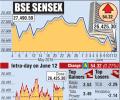
Oil, banks eneded the day in green while few in auto sector lost heavily.

Markets crashed due to domestic worries; bluechip stocks tanked too.
From the Sensex pack, Power Grid, Infosys, Asian Paints, Mahindra & Mahindra, HCL Technologies, IndusInd Bank, Tech Mahindra, Bajaj Finance, Wipro, Tata Consultancy Services, HDFC Bank and Titan were the major gainers. Tata Steel and Bharti Airtel were the laggards.
The BSE benchmark Sensex opened 145 points lower on Thursday after investors' confidence was shaken by Wednesday's serial bomb blasts in the country's financial capital, amid a weakening overseas trend.

Going 'long' is becoming an overcrowded trade on Dalal Street, and any negative trigger could lead to a sharp correction, warn experts. However, given the strong momentum, particularly in IT stocks, the downside could be protected in the immediate term. "With the Nifty50 surging to new life-time highs, the bulls remain in control. Further upsides are likely once the immediate resistance of 21,492 is taken out.

The bull market peak came in March 2015, at a Nifty intra-day value of 9,119.

Markets have gone into a tailspin, the Modi govt must revive investment sentiment.

'For 40 years, India valued only technical skills. IITs, coding -- that became everything.' 'Soft skills were sidelined. But those are the skills that will keep you employable now, not technical skills.'

Dalal Street investors were a poorer lot on Monday as their wealth eroded sharply by Rs 14 lakh crore following a sharp decline in benchmark indices amid a global market meltdown due to recession fears. The 30-share BSE Sensex tumbled 2,226.79 points or 2.95 per cent to settle at 73,137.90. Intra-day, the benchmark slumped 3,939.68 points or 5.22 per cent to 71,425.01.
Stock investors can expect another rollercoaster ride on Dalal Street this week as the equity markets remain vulnerable to meltdown in the US sub-prime mortgage

For investors who missed the initial IPO frenzy, the market correction is an opportunity to selectively invest in promising names, but patience and careful evaluation remain the key.

The story of the Bombay Stock Exchange and the people who shaped its growth: From wars and bomb blasts to speculators, reformers and wealth creators.

Among the 30 Sensex firms, Bajaj Finserv, IndusInd Bank, Tech Mahindra, Bajaj Finance, Kotak Mahindra Bank, Axis Bank, NTPC, and Sun Pharma were the major gainers. On the other hand, Bharti Airtel, ITC, Adani Ports, JSW Steel and Tata Motors were among the laggards.
BHEL, YES Bank, RCom, Titan Ind, JP Associates, BF Utilities, Ruchi Soya and Punj Lloyd have tanked more than 10% each on BSE.

The meltdown in Dalal Street that wiped out investor wealth to the tune of 44 trillion in 2025 also seems to be having a ripple effect on the country's vibrant automobile retail sales.

A day after facing massive erosion from their wealth, equity investors became richer by Rs 13.22 lakh crore on Wednesday with markets making a strong comeback. The 30-share BSE Sensex jumped 2,303.19 points, or 3.20 per cent, to settle at 74,382.24. During the day, it rallied 2,455.77 points, or 3.40 per cent, to 74,534.82.
About 24 mn shares of Infosys worth Rs 575 cr were traded on both the exchanges on Friday compared to a three-month daily average of 14.5 mn shares worth about Rs 365 cr.

Diwali fireworks are expected to continue on Dalal Street next week, with four companies collectively seeking to mobilise over Rs 6,600 crore through initial public offerings (IPOs). In terms of the amount raised, this is poised to be the busiest week of calendar year 2023. Tata Technologies (Tata Tech), a subsidiary of Tata Motors, could lead the charge with an IPO projected to be over Rs 2,900 crore. This will mark the first maiden share sale by a Tata Group firm in nearly two decades.

Dalal Street had a roller coaster ride in 2024 from shattering record after record to facing heavy correction off-late but equity markets still rewarded investors with positive returns, driven by a surge in domestic fund flows and a resilient macro landscape. The first half of the year saw robust corporate earnings, a surge in domestic flows, and a resilient macro landscape, driving the Nifty to an all-time high of 26,277.35 in September 2024, according to Motilal Oswal Wealth Management.

Dalal Street minnows stole the show in 2024, giving handsome returns to investors, helped by a largely optimistic trend in the stock market and impressive retail investors' participation. Analysts attributed the positive trend in the equity markets, where the benchmark indices shattered many records this year, to robust domestic liquidity, strong fundamentals of the Indian economy, and policy continuity.
 © 2026 Rediff.com - Investor Information - Advertise with us - Disclaimer - Privacy Policy - Sitemap - Feedback - About us - Terms of use - Grievances